
2026
The two most common designs for multi-port selector valves in the market are axial sealing configurations and radial sealing configurations. The advantage of an axial sealing design for the valve seat is its relatively simple manufacturing process, as well as the ability to implement either a soft seal or a hard seal depending on specific requirements. Its drawback, however, is that the overall valve size is larger, making sealing challenges more difficult to overcome under high-pressure conditions.
Radial sealing valve seats feature a more compact structural design, exhibit superior load-bearing characteristics, and are therefore well-suited for production in high-pressure environments. However, their drawback is that hard-sealing designs are complex to manufacture; consequently, both international and domestic manufacturers predominantly employ soft-sealing designs. Nevertheless, when operating under harsh conditions—such as with raw gas or crude oil—soft-sealing materials are prone to damage and wear, which can compromise sealing performance.
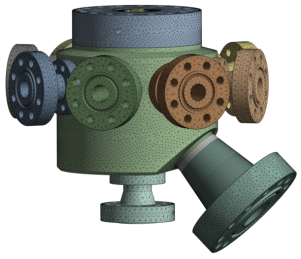
Based on market research and analyses of relevant domestic and international technologies, it has been demonstrated that, in the current market, there are virtually no cases of radial hard-sealed multi-port selector valves that simultaneously achieve a compact design, superior load-bearing characteristics, and an extended service life.
Based on product documentation and engineering research, major international manufacturers of multi-port selector valves include SCHUF, DAFRAM, and Fisher, among others. This product typically employs either axial or radial sealing designs, with soft-sealed configurations being the most common choice in engineering applications. Soft sealing leverages the elasticity of the sealing material to compensate for assembly errors; however, under operating conditions involving sand particles or high pressure differentials, such seals are prone to wear, and their service life remains uncertain.
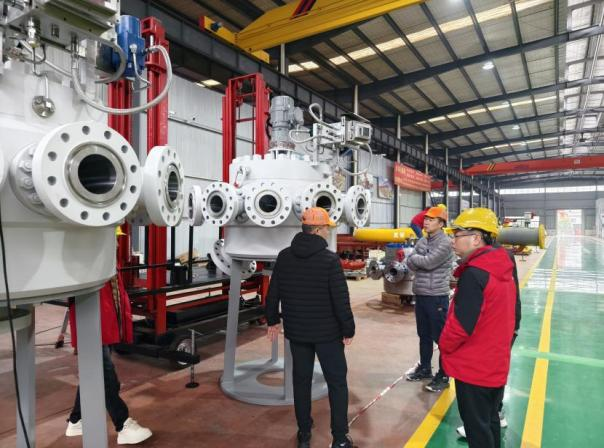
Chengdu Empire Company has been engaged in the development of multi-port selector valves for many years, and its product design features a radial hard-sealing configuration. In the field of axial hard-sealing, the manufacturing processes of both Chinese and international enterprises are relatively mature; however, radial hard-sealing requires addressing a range of challenges, including sealing surface conformity, contact pressure, rotational friction, and the accumulation of manufacturing errors. Current research literature predominantly focuses on the sealing materials and strength characteristics of conventional valves, while exploration of the radial hard-sealing structural systems for high-pressure multi-port selector valves remains relatively limited.
In summary, the design of a radial hard-sealed multi-port selector valve is not primarily about simply replacing the sealing material; rather, it focuses on establishing a synergistic system comprising key components such as error compensation and sealing verification. Even if the valve disc remains in full contact with the valve seat throughout its rotation and employs a high-strength alloy, the sealing surface may still be damaged due to the entrainment of abrasive particles or adhesive wear.
In the initial phase, key parameters—including the design pressure of 2500 lb, connection standards, and sealing grades—were determined; subsequently, the design and calculation of the overall system, pressure-bearing components, transmission parts, and sealing surfaces were conducted; next, the composition, hardness, microstructure, and penetration test results of the Stellite 6 & 12 laser cladding layers were investigated; computer-aided simulation analysis reports were prepared; and third-party inspection test reports were obtained.
Articles


